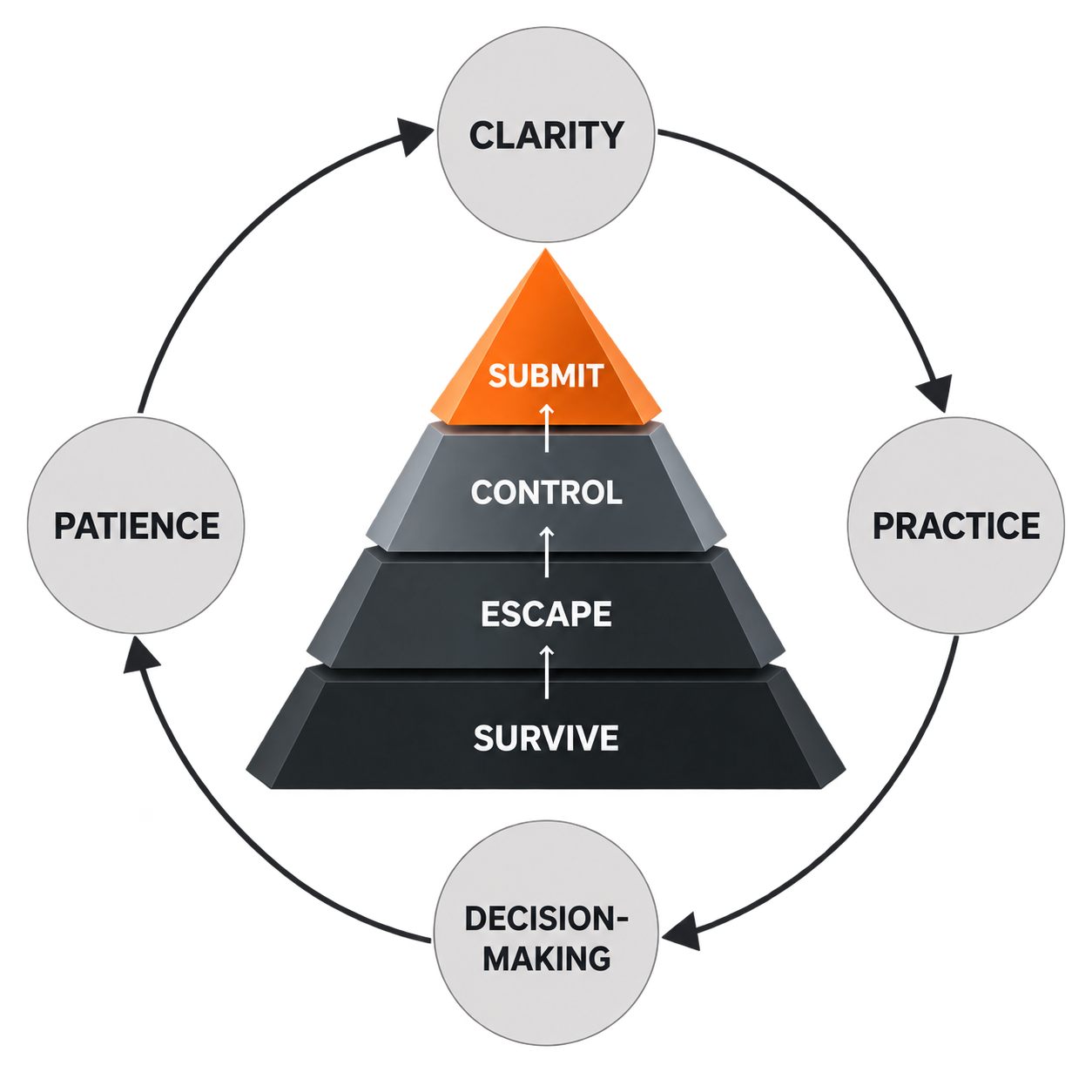
01. Clarity
We teach the reason before expecting the reaction. A technique should not be a sequence of movements a student has to memorize. There is a reason for the position, the pressure, the grip, the timing. Understanding that "why" gives students something more valuable than memory: a foundation they can build on. With adults, we break those ideas down clearly. With children, the same principles can be taught through movement and games. Different ways of teaching, with the same goal: understand first.
02. Practice
Understanding something is not the same as being able to do it. That comes through repetition. Students drill until movements become smoother and more fluid, then test what they have learned through positional training and live sparring. Slowly, the body begins to follow what the mind already understands. What once required thought starts to become movement.
03. Decision-Making
Jiu-Jitsu is a series of problems that rarely arrive exactly as expected. As students gain experience, they learn to recognize what is happening, understand why it is happening, and respond at the right moment. A mistake becomes something to identify. Then something to recognize earlier. Eventually, something to prevent. The goal is not to think about more techniques. It is to see more clearly and move when the moment calls for it.
04. Patience
There is timing inside Jiu-Jitsu, and there is timing in learning Jiu-Jitsu. Both require patience. Students progress through consistent training and demonstrated skill, but no two journeys move at exactly the same pace. Different bodies. Different backgrounds. Different experiences. Different amounts of time on the mats. Comparison does not make that process faster. Training does. You will lose positions. You will make mistakes. You will have days when things click and days when they do not. That is part of progress, not separate from it.